I'm sorta relieved that Marie Antoinette is getting encouraging reviews. Heaven knows we need more Joseph von Sternberg pictures, even of the Krispy Kreme kind.
Saturday, October 14, 2006
The Kinda Sorta Heartbreaker
Dierks Bentley posits himself as some kind of tough-to-tame heartbreaker, but I’m dubious. Most likely he’s the type of guy who’ll hook up with you at the bar for a one-night stand, no strings attached, and still leave you a manfully cryptic note the next morning making vague allusions to “not knowing where my head’s at,” full of references to how he just has to “ramble.” Toby Keith, meanwhile, isn’t leaving town until he’s fucked your sister. That’s a heartbreaker.
As a performer and personality Bentley’s genial enough but lacks an identity outside of styling himself as a regretful Lothario and an inveterate highwayman. Long Trip Alone represents a modest drop-off in quality from Modern Day Drifter mostly because Dierks is a little more sober and lyrically vague this time around. “Soon As You Can” carries a winning pop hook and “That Don’t Make It Easy Loving Me” is rowdy and cheeky like more of Bentley’s stuff should be, but a lack of specificity or new perspectives kills several of the ballads. “It’s all one song,” Neil Young famously claimed, but for Dierks it’s the truth. I guess I respect him for not sticking his foot in his mouth politically or being a pigheaded douchebag like Brad Paisley, but his breakup songs don’t pack nearly the devastation of Gary Allan or Julie Roberts and his traveling songs don’t offer the sickness and desperation of Shooter Jennings. “Slightly rueful” and “quixotically transient” aren’t really poses that lend themselves to a broadly satisfying body of work.
Friday, October 13, 2006
Blue collar angst
 As he did in I ::Heart:: Huckabees, Mark Wahlberg in The Departed, in a quiet, persistent way, steers the audience's attention away from the younger and better-looking leading men and women. Look at the frame I've selected, emblematic in a way: a ramrod-stiff Leo DiCaprio, his character uncomfortable in the first pair of decent JC Penny's khakis he's ever owned, the actor himself trying to overlook the fact that he hasn't worn pants this mousy since his high school graduation; and, facing him, Wahlberg, shrunken in an equally awful grey tie and purplish shirt, yet so present, comfortable in a way that DiCaprio isn't and may never be. Not for the first time, we wonder whether it had occurred to the talented director to switch roles. Called upon to project how bullishness can shift into a rudimentary moral sense, DiCaprio is as blank as Ray Liotta in Goodfellas. We don't accept him for one moment as a mole. Watch him as he listens to Jack Nicholson's florid arias: Goddamn, he thinks, look what you're allowed to get away with. It's enough, I suppose, that Scorsese cast Matt Damon as his doppelganger -- that other youngish thirtysomething actor whose acting is akin to observing a glass of ice-cold water sweat on a balcony. The friction DiCaprio's priggishness and Damon's almost fey professionalism (abetted by Thelma Schoonmaker's quicksilver editing) trigger odd crosscurrents. Does Scorsese believe that DiCaprio is A Good Man Inside or an ambitious cipher like Damon, who'd gladly give his colleagues the shaft for the sake of a promotion?
Back to Wahlberg: he played what is essentially the DiCaprio part in James Gray's The Yards (2000), the film's hypertrophied realism stifled the arc of his performance; you could feel him wanting to deepen the material beyond its pseudo-mimetic recreation of the blue collar crime world. But you understood that something was at stake. Listen to him snarl, "Who am I? I'm the guy who does his job. You must be the other guy" to a livid DiCaprio* in The Departed; there's a sliver of envy embedded in what is an otherwise pedestrian admission of professional responsibility. Suddenly an abyss opens between the audience and the director's expectations. A mid-level cop, supervising a feckless stool pigeon, whose self-righteousness is no comfort as he becomes aware of the machinations of the careerist (Damon) a few offices away. What a story. It's no wonder that agents prefer casting Wahlberg in movies like Invincible and The Italian Job.
*EDIT: Wahlberg actually says this to a fellow officer, not DiCaprio, as Apa correcty points out. I think the gist of my argument still works: Wahlberg, performing grinding tasks out of the spotlight, cursing loudly and often to create the illusion that he doesn't give a damn.
Of Trace Adkins and Tracy McGrady
Thanks to Alfred for that blush-inducing introduction. He and I do share a fair number of favored artists and popcrit pet theories, but hopefully I can bring a fresh perspective on the places where we diverge while also staking out on my own some of the cultural territory Alf doesn't generally claim. In other words, my twin incongruous passions are pop-country and the NBA, and while I promise to tread lightly with the latter, I just hope I can offer somewhere approximating the same level of erudition to my scattered obsessions (the glorious pop-metal of Damone, the glorious prose of Walker Percy, the glorious ineptitude of the Atlanta Hawks) as Alfred lends to Larry Levan, Henry James and his holiness Bryan Ferry.
Thursday, October 12, 2006
I hope we'll soon read our first post by our newest member. Besides a stint as one of our most avid readers and commenters, Joshua Love of Raleigh is also a critic whose wit and cogency make him a pleasure to read, as his work on Stylus, The Village Voice, and local newspapers in Georgia and North Carolina show. Josh drinks deeply of the Stones' Dirty Work and Faulkner, both of which compensate for his curious devotion to Fantasy Football and the Drive-By Truckers.
Wednesday, October 11, 2006
I'm mildly surprised that Lindsey Buckingham's solo albums haven't been subjected to the same revisionism which has made Fleetwood Mac's Tusk an essential recording. Maybe it's cuz I always suspect there's something missing, despite their charms. Under The Skin is the first one to hint that there's a world beyond Brian Wilson-esque hermeticism (if anything Brian Wilson-esque hermeticism is Buckingham's legacy to indie DIYers).
Tuesday, October 10, 2006
Goat's Head Soup
Thoughts on hearing "Hide Your Love," "Can You Hear the Music," "Dancin' With Mr. D," and "Silver Train":
On September 28th of this year, Jagger sang "Angie" in heavy makeup and leather boy drag on the ABC-TV/Don Kirshner Midnight Special. The night before, Mickey Rooney and Milton Berle sang some old musical comedy flytrap about what a hunk o' man Flo Ziegfeld was, and it was far more transexually elaborate. Berle's been doing this schtick for twenty years and Mick...had to wait for Alice Cooper and Bowie to make it all right.-- Lester Bangs, Creem, December 1973.
I also know people who think "Winter" is poesy of a high caliber.
Monday, October 09, 2006
*Ahem*
I hate querying posts, but I wanted to know if there's any essays or reviews concerning TV on the Radio. To date I've read not a single intelligent review of Return to Cookie Mountain. I think I like it, but Peter Gabriel circa 1977 singing atop Lust for Life-esque grooves with symphonic pretensions is not usually my cup of camomile.
Saturday, October 07, 2006
"And yet this great wink of eternity..."
 A lovely, jargon-free review by Adam Kirsch of the newly published Library of America edition of Hart Crane's collected poetry and letters. Perhaps no other modernist poet confounds notions of literalness; perhaps no other poet of that great epoch between 1915 and 1950 demanded so much from his readers (he makes T.S. Eliot look like Robert Frost, and Robert Frost look like Robert Frost), as evinced by the one time I taught him in a freshman lit class and was rewarded by a wave of anthologies hurled at my podium. He was one of the rare poets whose alcoholism abetted his principles; the half-lucid daze with which the sensitive spirit confront a vision of beauty required verse that risked incoherence in its attempt to limn moods and shades which remain at the edge of cognition anyway:
Then I might find your eyes across an aisle,
Still flickering with those prefigurations...
There is some way, I think, to touch
Those hands of yours that count the nights
Stippled with pink and green advertisements.
Wednesday, October 04, 2006
"Oh, the sun-drenched French girls..."
 The Rapture's first album missed me entirely*. I danced whenever I heard "House of Jealous Lovers" but avoided the rest, assuming that it was rank hipster jive (post-apocalyptic white kids steal post-punk dance moves, yawn) . Pieces of the People We Love, however, is a first-rate record, by far the best synthesis of 1981 sounds and post-Strokes attitudinal pop I've heard. "'The Devil" and "Get Myself Into It" conjure the gay-disco vibe with sturdier beats and tunes than I've heard the Scissor Sisters proffer; the former has an especially ominous swagger, like a shrieking cat-beast had figured out how to grope the rhythm of PiL's "Poptones" and lick ugly Mekons guitars. "First Gear" features the year's silliest refrain ("My-my-my-my-my-my-my Mustang Ford!") and the sexiest car-as-sex metaphor since R. Kelly's "Ignition." Luke Jenner's words may be confusing, but he's not confused; while he doesn't cop to after-party wisdom (the kind you know you'll forget as soon as the hangover ebbs) he keeps enough of his wits about him to recognize that one party's as good as another. Accepting the ephemerality of scenester fame positions him closer to the Prince side of the continuum than, say, former mentor James Murphy's: the cops are going to break things up soon, so let's not waste time on hamhanded irony (listen to LCD Soundsystem's "Losing My Edge" again). It's almost impossible to parse Jenner's sexuality, which is probably how he wants it. What is admirable is the band's commitment to self-reliance, and not the kind infused by mere "positivity" either (except on the closer and sole dud "Live in Sunshine," a compendium of greeting-card maxims set to a raga melody evoking the Chemical Brothers circa 1999). Take "Down For So Long":
Then an analyst said, "Why fret finality?"When, four albums after their debut, New Order released their own manifesto ("All The Way") it swung with a loose, earned ferocity. Their career trajectory suggests a model worthy of study: how to take drugs, record brilliant music, and maintain your savoir faire. As for The Rapture, their dreams may go up their noses by the next album but after careful examination of the evidence The Rapture are (a) aware of it; (b) will make all the guest lists anyway, even if they can afford the DFA and Danger Mouse just once.
Cuz lookin' up ain't nothing lookin' down on me
*EDIT: Shows how much I know about this band. I had no idea The Rapture released an album before Echoes.
Tuesday, October 03, 2006
Musicians: no acting experience necessary
 I've long been fascinated by what prompts a musician to pursue an acting career. Do most of them assume that their personae will remain compelling when transposed to another medium? What combination of lucre, hubris, and desire for world conquest motivates them?
I rank the five best. If you think Bogart and Christopher Walken have had uneven career arcs, you haven't looked at Frank Sinatra or Liza Minnelli's.
"He doesn't look a thing like Jesus"
The new Killers album reviewed here. Anthony insists that this is their Born in the U.S.A.; if it were, I argue, it'd be shorter, the lyrics more concrete, Flowers' attitudes more ambivalent. After this debacle, let's hope that Brandon Flowers has enough gumption to record a semi-acoustic, synth-anchored Tunnel of Love.
Monday, October 02, 2006
How it looks so far...
(in no order)
ALBUMS
Ghostface - Fishscale
Yeah Yeah Yeah's - Show Yr Bones
Scritti Politti - White Belly, Black Beer
Sonic Youth - Rather Ripped
Basement Jaxx - Crazy Itch Radio
Various Artists - Journey Into Paradise: The Larry Levan Story
Pet Shop Boys - Fundamental
The Rapture - Pieces of the People We Love
Justin Timberlake - Futuresex/Lovesound
Prince - 3121
Bob Dylan - Modern Times
Pearl Jam - s/t
Hot Chip - The Warning
Gnarls Barkley - St. Elsewhere
Ne-Yo - In My Own Words
SINGLES
Ne-Yo, "Sexy Love"
Mary J. Blige, "Be Without You"
Escort, "Starlight"
Justin Timberlake, "SexyBack"
Timbaland feat. Nelly Furtado, "Promiscuous"
Gnarls Barkley, "Crazy"
Madonna, "Sorry"
The Killers, "When You Were Young"
Sonic Youth, "Incinerate"
Franz Ferdinand, "Walk Away"
Sunday, October 01, 2006
Update: I'm not dead; I still enjoy the company of blondes.
I got this e-mail today, while at the library writing a legal memo, and though I haven't in any way ruled out the possibility that the writer--his name is Jay Peterman for chrissake--is someone playing an elaborate prank on me, even my modest ego is not immune to the occasional masturbatory suspension of disbelief, and I will post it.
Hi, Andy. There was a guy who looked exactly like you this afternoon at the Subrageous next to FIU. If that was you, who was that unbelievable blonde you were with? Holy cow, she was smokin' hot!I haven't abandoned the blog. I still fantasize about one day returning to the blogosphere, but as a first year law student, I haven't had time to even keep up with the news. I'm told it gets much better on your second year--let's hope. In the meantime, you can still enjoy the posts of AGI's other contributors, who are just as talented, but far more committed than I can be right now.
In case you're wondering how I know what you look like, I saw your picture on your blog. Which, by the way, is a very entertaining read. Why have you abandoned it?
Jay
Dropping science like Galileo dropped an orange
 David Lynch is the only contemporary director who's approximated the danger of Luis Bunuel's Mexican-era dream sequences; Michel Gondry is the only contemporary director who's approximated the playfulness of Bunuel's French-era dream sequences. Fey and detached, The Science of Sleep relies entirely on the charm of its actors, not the least of which is Gael Garcial Bernal, whose intensely erotic mouth must intone dialogue in French, Spanish, and English; his skewed line readings give exchanges like "I like your boobs: they are simple and unpretentious" a sophomoric awe that mitigates the smut. A compelling camera subject, Bernal projects enough sexual magnetism to kick against the froth. Charlotte Gainsborough makes a worthy foil, for a while; we can understand why he's fascinated by this woman, who looks him straight in the eye when calling his bullshit and is intoxicated by him anyway. Beyond that, though, she's a vaporous heroine, called into existence by Bernal's poseur-scientist. Their relationship lacks the erotic tension of Jim Carrey and Kate Winslet's in Eternal Sunshine of the Spotless Mind; not the least of the earlier film's insights into romance is the realization that turmoiled recollection aggrandizes the banal mechanics of a failed relationship.
Like Bunuel's The Phantom of Liberty, the jokes in The Science of Sleep exist for their own sake. The Shakesperean fools in Eternal Sunshine (a game Kirsten Dunst, Elijah Wood, Mark Ruffalo, and Tom Wilkinson)... represented genuine relief from Carrey and Winslet's angst; in The Science of Sleep it's as if Twelth Night's Feste took over Othello (here Feste is incarnated by Alain Chabat's droll, vulgar Guy). I'm loath to give Charlie Kaufman credit for ESOSM's achievements since nothing in his previous work suggested he cared enough about human relationships, but I can't shake the suspicion that Gondry can create these formalist exercises in predictable surreal frivolity for the next 20 years.
Friday, September 29, 2006
Reason #351 Why The Pet Shop Boys Rule
It's found in the (out of print, alas) Chris Heath-authored Pet Shop Boys, Literally. Neil Tennant recalls an unrecorded song from their early days called "Oh Dear."
CHRIS: It was dead funny. What were the lyrics?
NEIL: The tune sounded like the Specials and it went:
I was walking down the high street in the middle of the night(They both collapse into hysterics)
Someone caught my eye and I nearly died of fright
Crossed the road to whisper something secret in my ear
And now I know I'll never be the same again
Oh dear
Wednesday, September 27, 2006
Sensuality withheld
 I'm miffed at Jane Dark for noticing details in Clean that I'd jotted down but failed to remark on in my post. Olivier Assayas's dispassionate camera, for example, simply observes Maggie Cheung devouring a cheeseburger and onion rings. We note quietly that it's probably the first junk food she's eaten after six months in the clink. We note also that Assayas doesn't linger on the scene, almost out of tact; she takes two or three bites at a time, stuffs the o-rings in her mouth, and we cut quickly to Nick Nolte, whose own gaze appraises but won't commit to a judgment -- yet.
Staring into space and calculating, figuring things out, waiting for the recoil he uncertainly expects from Cheung after each of his polite, hopeful rhetorical brutalities. They never come.If I may permit myself a splendid generalization, Nolte's performance is the truest representation of goodness I've seen in recent cinema. His is a generosity of spirit leavened by the awareness that he courts humiliation at each juncture.
"Gone and blown it all..."
After months of ignominious banishment to the nether regions of my hard drive's music folder, I unearthed the Wire remix of Erasure's "Fingers & Thumbs (Cold Summer's Day," renamed "Fingers & Crumbs" – appropriate, since this isn't so much a revision as a reinvention. Colin Newman casts Andy Bell's wounded tenor adrift on a sea of arctic-blue electric guitar strums, worthy of Wire's It's Beginning to & Back Again; it's 9:30 of lovelorn trance, and much the most powerful music Bell's put his name on. "Gone and blown it all" he repeats, growing more desolate with each gradation, until – in a neat reversal of Newman's own vocal at the beginning of Wire's "Heartbeat" – he disappears into the ether.
If anyone wants a copy, let me know.
Monday, September 25, 2006
Modern life is not rubbish
 Forget Antonioni: Jacques Tati had the right attitude towards the trendiest trope in early sixties cinema: the soullessness of Modern Life. In Playtime, newly restored in a Criterion edition which can only be described as incandescent, Tati is more bemused than sad by modernity; he catches people who love the chic new toys but stumble when they try to make them work, but instead of laughing at them his 70 mm compositions reminds us that they're part of something larger even if they're oblivious to it, or -- in the case of Monsieur Hulot -- can't understand it. Plate-glass windows never looked tastier; you can almost chew on their gleaming surfaces. The soundtrack captures a city hip to its own trendiness. The buzz of a drugstore's electric sign has a soothing effect, as does the emerald glare the sign casts on Hulot and the patrons. For the American tourists stepping out of tour buses, Paris is the place to be because it's just like America; and wasn't this the idyll that post-modern advertising promised to realize? Every city is just like your city. Playtime argues that the sterility of Cold War architecture is a palliative against the corrosive effects of the job for which you're working in that building in the first place; that architecture and noise pollution can be part of the "experience" of modern life*, which is what I infer from studying Walt Disney World's Contemporary Resort Hotel and Tomorrowland in their seventies incarnations.
The familiar Hulot is peripheral to his own film, a wraith in a trenchcoat. This fact and the recurring sight gag of the restaurant valet imitating a door by holding a massive knob is perhaps the closest Playtime approaches didacticism: if we love our things we become things. But in this tinkerbox world, is that so bad?
The worthiest compliment I can pay to the restaurant sequence which dominates the second half is that it summons the gleeful grownups-playing-naughty air of Viridiana's Last Supper scene, or, better, L'Age D'Or. Where the creator of L'Avventura and La Notte would have tut-tutted watching his revelers carouse as a restaurant (literally) collapses on and around them, Tati can't begrudge them their fun. The fat American who gets mistakenly bumped from table to table, rather than losing his temper, is cheerful when the waiter switches a footlight on with an abrupt kick. Again, the compositions' expansiveness implicate the viewer too. Try to resist this, Tati seems to say.
This film is the best evidence that Franco-American aesthetic policy is fruitful in a way that foreign policy never will.
* Isn't this what Pere Ubu's The Modern Dance and Dub Housing suggest too? The difference is in the privileging of senses. Playtime emphasizes aural and audio stimuli while the Ubu stuff emphasizes aural and olfactory, in an imaginative sense; you can practically smell the exhaust fumes from the Rustbelt factory backdrops.
Sunday, September 24, 2006
Two books
I wanted to hate Marisha Pessl's "Special Topics in Calamity Physics." 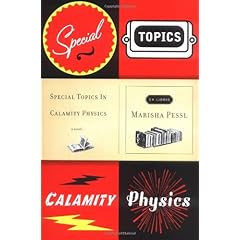 You can tell right away she has pedigree and her idea of hard work is lifting her Norton Anthology from the Louis Quatorze desk. But I ended up liking it all, even when she was scrubbing my face on how smart she was. It's a good gimmicky book. Read it.
I'm also recommending Scott Smith's "The Ruins" 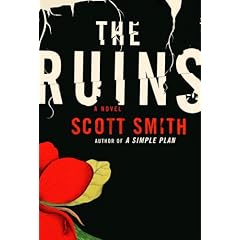 Yes, I know Stephen King did it, and, no, the novel doesn't deliver anything more than very taut thrills, but... well, how often are you thrilled?
So fresh, so Clean
 What makes Maggie Cheung's performance in Clean so marvelous is her understanding of how her ex-junkie's impatience and hauteur are proxies for heroin. They're defenses against seemingly hostile forces: relatives who get you a menial job so that they can, in part, remind you of their generosity; former friends who won't tell you if they ever really liked you or merely tolerated you; and even the genuine compassion of a father-in-law (Nick Nolte, finding new cracks in that gravelly voice). The Parisian babel in which writer-director Olivier Assayas, who divorced Cheung shortly before filming, places Cheung looks wonderful in the grey light. Cheung, lighting endless cigarettes, looks great despite hair that looks like it was mauled by hedge clippers. His talent for marrying music with images remains intact, though: here it's Brian Eno's swirling, murky Apollo soundtrack, the title track to Taking Tiger Mountain (By Strategy) and "Spider & I."
Most of the reviews didn't do justice to this film's quiet power. The dialogue is unremarkable and honest (as when an acquaintance, visiting Cheung in prison, responds to her question about whether methadone truly makes you feel better: "Depends on the person. Not for me"). If no images sear themselves in the brain as indelibly as Cheung's imitation of a cat burglar, scored to Sonic Youth's "Tunic (Song for Karen Carpenter)" in Irma Vep, maybe there's more at stake for Assayas' characters. There's only one (early) scene showing Cheung shooting up. Clean deals with the aftermath. Just "getting by" is painful: crossing a street corner, driving a scooter, concentrating on a game of pool while a friend listens to demos which represent the last attempt at forging a career.
It's out on DVD.
Wednesday, September 20, 2006
Hard work and songcraft mitigate assholism
 I'm very fond of Sting's The Soul Cages, the only solo album on which his poetic pretensions find appropriate, pretty settings. Since this is Sting he's incapable of considering that ponderous subjects may be more interesting if treated with levity. The endless closer "When The Angels Fall" falls and falls, searching for a melody, anything to justify itself and its employment of worn tropes (and yet a feisty deejay played this at my junior prom, to my delight if not my date's). Elsewhere his crack band injects a tricky time signature on "Jeremiah Blues (Part 1)" as predictable as their paymaster's wit and even stoops to power chords on the epic (there's three songs which qualify as such; remember this is Sting), broken-kneed shuffle of the title track.
Yet there's a sense in which Sting's commitment to the myth of his upbringing (destitute Newcastle shipbuilder dies to give birth to the once and future King of Pain) frees him from sullying his genius on the creation of hits and such. At least half of TSC's tracks allude to his childhood, and each improves on its predecessor, as if he was a writer discarding incomplete drafts. He works damn hard here, and while the strain shows the results are often impressive. The album's lone hit, "All This Time" is one of the oddest Top Fivers ever: a striking mandolin hook ("Losing My Religion," the year's other mandolin hit, was three months away) and Sting's mastery of conversational cadences; he unfurls those polysyllabic sentences ("Fussin' and flappin' in priestly black like a murder of crows") as if Paul Simon had never existed. "Why Should I Cry For You?" should get more publicity as his most ambiguous ballad since "Every Breath You Take." Sounding a little like Peter Gabriel's "In Your Eyes" and studded with unexpected filigrees, it shows a rueful, gentler Sting, whose dusky croon weighs each word like he can't understand why he should feel conflicted. The sailor-far-from-home metaphor mitigates the assholism he's surprisingly eager to accept (""I loved you in my fashion"). It's a touching performance, justifying the song's inclusion in a couple of C-90's I've compiled over the years.
From its doctor's-office cover art to Ottmar Liebert homage/pastiche, The Soul Cages is estimable middlebrow art. It's the sort of album your cousin Ralph will zealously defend at a Christmas party, provoking from you a condescending smirk but no rebuttal.
Monday, September 18, 2006
Plush kitsch is still kitsch
 Sure, I grant Joseph Von Sternberg his due -- as a creator of grand, exquisitely lit recreations of fantasy worlds in which Marlene Dietrich scabrously glowered. As much as I adore The Blue Angel, Morocco, and The Scarlet Empress, I can't quite endorse Graham Fuller's claim that Sternberg reveals "cold, cruel truths about love," especially when the cold cruel truth is that, with the exceptions of Gary Cooper and Emil Jannings, her leading men were sticky wickets like Clive Brook (and, sadly, the young Cary Grant) for whom love was as irritating as a warm gin and tonic. Of course, as if to compensate, the cocoons in which Sternberg encased Dietrich became increasingly elaborate. I'm reminded of Orson Welles' demurral in that book of interviews he composed with Peter Bogdanovich: "He had a perfect, really an immense visual command, over what is finally kitsch" (Bogdanovich's ascot wrinkled defensively, no doubt). I'm uncomfortable with granting kitsch a value beyond itself, even when it's as plush and intoxicating as Sternberg's.
Yes, Eric Stolz and Dan Aykroyd are rather good
Terence Davies' adaptation of The House of Mirth is simply one of the most underrated films of the new millenium. Rent it.
Sunday, September 17, 2006
Call it Emmylou Harris Syndrome
A backup singer known for sterling anonymity courts obliquity when she becomes a lead vocalist. Every other featured player on Jennifer Warnes' version of Leonard Cohen's "First We Take Manhattan" sears: Stevie Ray Vaughan, the vulgar gleam of the synthesizers, Cohen's vampiric lyrics. Meanwhile, I didn't buy a note of Warnes' vocal; she sounds like Pat Nixon imitating Dennis Hopper. Why is she more convincing on her big hit, released the same year as her modest selling Famous Blue Raincoat -- "(I've Had) The Time of My Life", her schlockarama duet with Bill Medley for the Dirty Dancing soundtrack? Guess the L.A.-approved euphoria of the song's melody and words jived with Warnes' own aesthetic.
Crestfallen, I replayed my second-favorite Cohen album Various Positions. Well, I was floored all over again by the heartbreaking manner in which she cushions Cohen's croak on "If It Be Your Will." I'm wary of angel metaphors, but Warnes does sound like a some kind of celestial guardian offering the peace Cohen demands (her trills at the 3:19 mark are goosepimply perfection).
Saturday, September 16, 2006
"It's September in Iraq..."
This chilling story slated to run in tomorrow's Washington Post chronicles the unfathomable layers of cronyism that went into the rebuilding of Iraq. This is how political appointee Jim O'Beirne (whose wife Kate is an editor of National Review and a frequent guest on "Meet the Press") selected the best and brightest were selected:
O'Beirne's staff posed blunt questions about domestic politics: Did you vote for George W. Bush in 2000? Do you support the way the president is fighting the war on terror? Two people who sought jobs with the U.S. occupation authority said they were even asked their views on Roe v. Wade .But don't worry. Those hired worked tirelessly:
Many of those chosen by O'Beirne's office to work for the Coalition Provisional Authority, which ran Iraq's government from April 2003 to June 2004, lacked vital skills and experience. A 24-year-old who had never worked in finance -- but had applied for a White House job -- was sent to reopen Baghdad's stock exchange. The daughter of a prominent neoconservative commentator and a recent graduate from an evangelical university for home-schooled children were tapped to manage Iraq's $13 billion budget, even though they didn't have a background in accounting.
But many CPA staff members were more interested in other things: in instituting a flat tax, in selling off government assets, in ending food rations and otherwise fashioning a new nation that looked a lot like the United States. Many of them spent their days cloistered in the Green Zone, a walled-off enclave in central Baghdad with towering palms, posh villas, well-stocked bars and resort-size swimming pools.
Friday, September 15, 2006
(This is not a) dance song
 What do my fellow critics hear in the Junior Boys and Hot Chip? With their polite beats and the vocal-as-embarrassed-afterthought mouthing sentimental vagaries, this is dance music for people who don't like to dance very often (I don't go so far as to claim -- as one buddy said -- that it's music for people who don't like dance music). I'm rather fond of Hot Chip's The Warning, a tuneful minor success that mines two veins of disco: the absurdist ("Over & Over") and the obsessive "([Just Like We] Breakdown"); but, jeez, I didn't shudder as its world-historic importance sat on my head. Meanwhile So This is Goodbye really skimps on the melodies in favor of "textures" or something -- or, in the words of a contemporary, creators of moments that "refuse to be architected." (I didn't know that was a verb either). It says a lot that the album's most memorable tune is a Frank Sinatra song -- and a lugubrious one too. I couldn't listen to Frankie Knuckles for more than 10 minutes at a time myself.
Oh, that new Pope, he kills me...
http://news.yahoo.com/s/ap/20060915/ap_on_re_mi_ea/pope_muslims_14
There's a lot of hilarious things about the new controversy and this article. If I may resort to broad strokes, let me point out the obvious funny highlights:
-The Pope commenting on the war-like ways of Islam by quoting a text from the Middle Ages. And we all know how peaceful the Catholic Church was during the Middle Ages.
-"How dare the Pope say we're violent?!?" say Muslims caught in a "a torrent of rage that many fear could burst into violent protests."
- The Pope quoted a text on how Islam allows for jihads. "He's ignorant about Islam!" Hmmm, no, he's right. Islam DOES allow for jihads. And that's a problem. See, when a "Christian" president starts a war, he's EXPRESSLY going against Christian doctrine. But Muslim doctrine does encourage war as a way of spreading the faith. And yes, I've read the Q'ran, as I'm sure the Pope has.
-Muslim officials all agree that Pope's comments are "derogatory". What no Muslim official has been able to say is that the Pope's comments are FALSE. Food for thought.
-This paragraph is awesome:
"The pope and Vatican proved to be Zionists and that they are far from Christianity, which does not differ from Islam. Both religions call for forgiveness, love and brotherhood," Shiite cleric Sheik Abdul-Kareem al-Ghazi said during a sermon in Iraq's second-largest city, Basra.
Translation: "Christianity and Islam maaay be able to get along. The ones we need to kill are the Jews."
My verdict- my humble, unlearned opinion:
The Pope's dumb for saying this. But he's not quite LYING, is he?
Fanaticism sucks.
And Jihads are deadly.
I need not touch on my own religious views, except to remind you that Islam forbids the use of alcohol. FORBIDS. I'm gonna stick with party animal Jesus.
In your eyes...
Check out the photography of George Steinmetz. His photos have appeared in National Geographic and various science and travel magazines. The camel photo on the front page is incredible.
I'm also partial to the Armani billboard. Look under "Identities", then at the photo on the bottom right; it's one of the light-haired man wearing sunglasses.
Subscribe to:
Posts (Atom)
